- The CyberLens Newsletter
- Posts
- Self-Learning AI Agents for Proactive Threat Defense
Self-Learning AI Agents for Proactive Threat Defense
Building Intelligent Resilience for the Autonomous Security Era

Devona Green Jordan
January 13, 2026
In partnership with


Your competitors are already automating. Here's the data.

Retail and ecommerce teams using AI for customer service are resolving 40-60% more tickets without more staff, cutting cost-per-ticket by 30%+, and handling seasonal spikes 3x faster.
But here's what separates winners from everyone else: they started with the data, not the hype.
Gladly handles the predictable volume, FAQs, routing, returns, order status, while your team focuses on customers who need a human touch. The result? Better experiences. Lower costs. Real competitive advantage. Ready to see what's possible for your business?

⚙️ Interesting Tech Fact:
Researchers working on ARPANET, in the 1970s,— the precursor to the modern internet — quietly experimented with primitive automated intrusion detection logic using statistical traffic anomalies, long before the term “cybersecurity” even existed. These early systems could only flag unusual packet volumes, but the idea planted the first seed of machine-assisted defense decades before AI was practical. What’s fascinating is that today’s self-learning AI agents are essentially the evolved descendants of those humble experiments, now operating at planetary scale with real intelligence 🚀🧠📡

Introduction
In an era where cyber threats evolve faster than human response cycles, the security industry is undergoing a decisive transformation. Traditional rule-based detection systems, signature matching, and even first-generation machine learning platforms are no longer sufficient to counter adversaries that themselves use artificial intelligence, automation, and adaptive malware. The next strategic evolution is the emergence of self-learning AI agents for proactive threat defense — autonomous systems that continuously learn from live environments, predict emerging attack patterns, and actively neutralize risk before damage occurs. This shift moves cybersecurity from reactive defense into a predictive, adaptive, and intelligent operating model.
Self-learning AI agents operate as continuously improving digital defenders embedded across networks, endpoints, cloud platforms, and identity systems. Unlike static models trained once and periodically updated, these agents ingest telemetry in real time, adjust their internal reasoning, and optimize decision-making autonomously. For organizations seeking to build digital trust, operational resilience, and future-ready security architectures, this strategy represents not simply a new toolset but a fundamentally new way of thinking about cyber defense. Professionals, educators, and technology leaders increasingly recognize that autonomous security systems will define competitive advantage and risk posture for the next decade.
Understanding Self Learning AI Agents in Cyber Defense
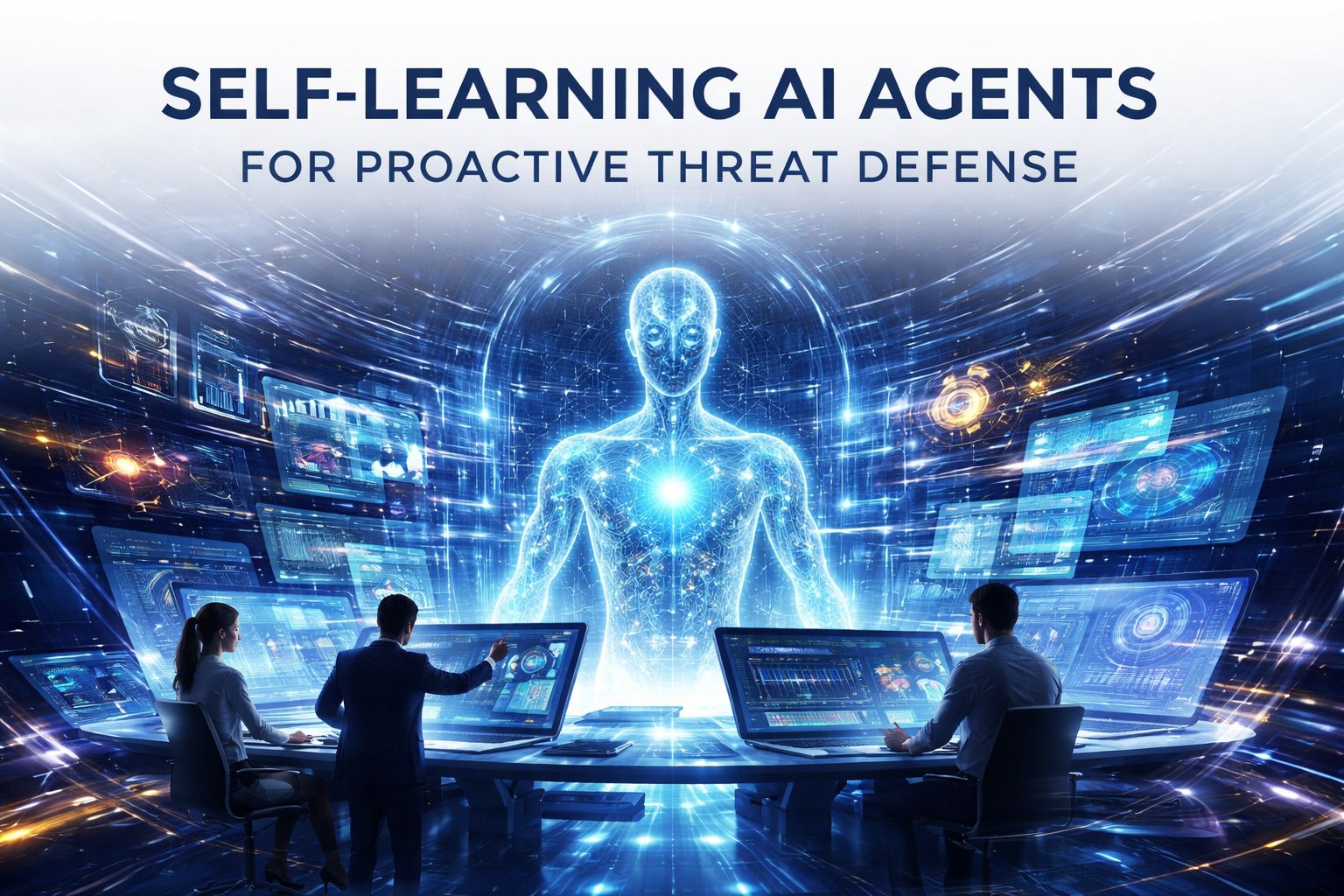
Self-learning AI agents are autonomous software entities designed to observe their environment, analyze data streams, make decisions, and continuously refine their behavior through feedback loops. In cybersecurity, these agents ingest vast volumes of telemetry such as network flows, authentication events, endpoint behavior, application logs, API activity, and threat intelligence feeds. They build contextual models of what constitutes normal behavior across users, devices, applications, and infrastructure. As the environment changes — whether through new business workflows, cloud migrations, or user patterns — the agent adapts without manual retraining or rule updates.
What distinguishes self-learning agents from traditional automation is their capacity for independent optimization. Instead of relying solely on predefined thresholds or static playbooks, they evaluate outcomes, learn from successes and failures, and recalibrate their internal models dynamically. When an anomalous pattern emerges, the agent does not simply generate an alert; it assesses risk probability, correlates signals across domains, predicts potential blast radius, and can initiate containment actions automatically or with human oversight. This transforms cybersecurity from a reactive alert-driven discipline into a continuously learning defense ecosystem.
Functional Architecture and Decision Intelligence
At the core of self-learning AI agents lies a layered architecture combining data ingestion pipelines, feature engineering engines, adaptive models, reinforcement learning loops, and policy orchestration layers. Telemetry flows into high-performance data fabrics where features are extracted in real time, normalized, and enriched with contextual metadata such as identity, geolocation, device posture, and application sensitivity. These features feed adaptive models that learn behavioral baselines and detect deviations with probabilistic confidence rather than rigid thresholds.
Decision intelligence emerges through feedback mechanisms. When an agent executes an action — such as isolating a device, throttling traffic, revoking credentials, or triggering forensic capture — it evaluates the outcome against defined success metrics like threat containment, user impact, and system stability. Reinforcement learning algorithms adjust future decision weights based on these outcomes, gradually improving response precision and minimizing false positives. Over time, the agent becomes more accurate, faster, and more contextually aware, enabling machine-speed defense that evolves alongside the threat landscape.
Operational Implementation Across Modern Environments
Implementing self-learning AI agents requires integration across the digital ecosystem rather than isolated deployment. Data pipelines must aggregate telemetry from cloud platforms, on-premise systems, SaaS environments, identity providers, operational technology, and developer pipelines. High-quality data governance, normalization standards, and secure transport are essential to ensure the AI learns from accurate and trustworthy inputs. Organizations must also establish secure control planes where AI agents can execute actions safely and auditable logs capture every decision for compliance and oversight.
Operational rollout typically follows a phased maturity model. Initial deployments run in observation mode, learning behavioral baselines and validating detection accuracy without enforcing automated actions. Once confidence thresholds are achieved, controlled automation begins in low-risk segments, such as sandbox environments or non-production workloads. Gradually, automation expands to production systems with guardrails, approval workflows, and rollback mechanisms. This staged approach balances innovation velocity with operational safety while building organizational trust in autonomous security systems.
Network Specific Implementation Strategies
Different network architectures demand tailored deployment strategies. Enterprise hybrid networks require deep visibility across legacy infrastructure, virtualized workloads, cloud platforms, and remote endpoints. AI agents must correlate east-west traffic, identity signals, and application telemetry to detect lateral movement and privilege escalation patterns. Zero trust segmentation and identity-centric telemetry become foundational to enabling high-fidelity learning and precise automated responses.
Cloud-native and micro-services environments emphasize API behavior, container telemetry, orchestration events, and workload identity. AI agents must integrate with Kubernetes control planes, service meshes, and CI/CD pipelines to detect supply chain compromise, credential misuse, and configuration drift. Industrial networks and operational technology environments require passive monitoring, deterministic modeling, and safety-first automation due to physical system constraints. Tailoring learning models and response boundaries to each environment ensures reliability while preserving operational continuity.
Organizational Fit and Strategic Alignment
Self-learning AI agents deliver the greatest value to organizations operating at scale, velocity, and complexity. Large enterprises, financial institutions, healthcare systems, global SaaS providers, and critical infrastructure operators benefit from continuous autonomous monitoring across distributed environments. High-growth digital businesses also leverage these systems to scale security capabilities without linear increases in staffing or operational overhead.
Educational institutions, research organizations, and innovation labs gain value by using AI agents as learning platforms that demonstrate advanced cybersecurity concepts, adaptive intelligence, and real-world threat modeling. Mid-market organizations increasingly adopt managed autonomous security platforms that abstract complexity while delivering machine-speed protection. Strategic alignment requires executive sponsorship, security maturity readiness, strong governance frameworks, and cross-functional collaboration between security, IT, data science, and compliance teams.

Trust Enablement and Governance Integration
Trust is not diminished by autonomy when designed correctly; it is strengthened through consistency, transparency, and measurable outcomes. Self-learning AI agents enforce policies uniformly, reduce human error, and respond faster than manual operations. By embedding explainability layers, audit trails, and decision attribution, organizations can demonstrate why an action occurred, what data informed it, and how outcomes were measured. This transparency builds confidence among regulators, executives, and operational teams.
Governance frameworks define acceptable risk thresholds, escalation policies, and ethical boundaries for autonomous decision-making. Human-in-the-loop oversight remains essential for high-impact actions, regulatory environments, and sensitive systems. Trust also extends externally — customers, partners, and stakeholders increasingly expect organizations to operate resilient, intelligent security infrastructures that protect data integrity, availability, and privacy at scale.
Limitations, Risks, and Future Outlook
Despite their transformative potential, self-learning AI agents introduce challenges. Data bias, incomplete telemetry, adversarial manipulation, and model drift can impact decision accuracy if not continuously monitored. Over-automation without proper governance may lead to unintended service disruptions or compliance concerns. Skills gaps, integration complexity, and cultural resistance to autonomous systems can slow adoption if not proactively addressed.
Looking forward, self-learning agents will evolve into collaborative multi-agent ecosystems capable of sharing intelligence across organizations, industries, and supply chains. Advances in federated learning, privacy-preserving analytics, and neuromorphic computing will further accelerate performance while reducing operational risk. As attackers increasingly automate their campaigns, defenders must match speed, scale, and adaptability. Autonomous AI defense will become a foundational pillar of digital resilience, shaping cybersecurity strategies for decades to come.
Best Implementation Strategies
Establish unified telemetry pipelines to ensure high-quality, normalized, and secure data feeds across all digital assets.
Deploy staged autonomy models starting with observation mode before enabling controlled automation in production environments.
Integrate identity centric visibility to strengthen behavioral context, anomaly accuracy, and zero trust alignment.
Implement explainability and auditability layers to support governance, compliance, and operational transparency.
Adopt adaptive policy orchestration frameworks that dynamically align AI decisions with business risk thresholds.
Continuously validate model integrity through drift detection, adversarial testing, and feedback loops.
Invest in cross functional enablement to align security, IT, data science, and leadership around autonomous operations.

Final Thought
Self-learning AI agents for proactive threat defense represent more than a technological upgrade; they signal a paradigm shift in how organizations perceive risk, resilience, and operational intelligence. In a world where digital systems underpin economic stability, healthcare delivery, education, and national infrastructure, cybersecurity must operate at the same velocity and sophistication as the threats it confronts. Autonomous learning systems enable defenders to anticipate change rather than chase it, embedding intelligence directly into the fabric of digital operations.
For professionals, this evolution expands strategic responsibility beyond tool management into system design, governance, and ethical leadership. For educators, it offers a living laboratory of adaptive intelligence, cyber physics, and operational resilience. For enthusiasts, it demonstrates how artificial intelligence can responsibly amplify human capability rather than replace it. Organizations that invest early in autonomous security architectures will not only strengthen protection but also cultivate trust, scalability, and long-term competitive advantage in the autonomous digital economy.

Subscribe to CyberLens
Cybersecurity isn’t just about firewalls and patches anymore — it’s about understanding the invisible attack surfaces hiding inside the tools we trust.
CyberLens brings you deep-dive analysis on cutting-edge cyber threats like model inversion, AI poisoning, and post-quantum vulnerabilities — written for professionals who can’t afford to be a step behind.
📩 Subscribe to The CyberLens Newsletter today and Stay Ahead of the Attacks you can’t yet see.